Vill du också ha tillgång till vårt videobibliotek?

  • 2500 videor
  • Ingen bindningstid
  • Testa utan kostnad

Välkommen till vår blogg

Yoga, träning och hälsoinspiration för dig

Restorative yoga hemma – två enkla övningar

Restorative yoga hemma – två enkla övningar

28 december 2020 | Av
Yogobe

Att ta stunder för vila och återhämtning under dagen är avgörande för att leva ett balanserat och hälsosamt liv. Med restorative yoga ger du kropp och själ tillfälle att få slappna av och återhämta sig. Här ger vi tips på två enkla restorative positioner som du kan göra hemma.

Ta en stund för återhämtning med restorative yoga

De dagar vi har varit i konstant rörelse och gått från den ena aktiviteten till den andra så kan det kännas tungt att kliva upp på yogamattan och röra på kroppen, och det kanske faktiskt inte heller är det vi behöver just då. Att balansera ett aktivt liv med återhämtning är essentiellt för vårt välmående och därför är det viktigt att få in tid för vila under dagarna. Restorative yoga är yogaformen som går ut på just det – att vila och att låta kropp och själ få återhämta sig.

Gör restorative yoga på lunchen, efter jobbet eller innan du ska och lägga dig. Du behöver inte göra ett helt pass för att ta del av de välgörande effekterna, en position kan räcka för att låta kroppen få återhämta sig en stund.

Förberedelser för restorative yoga – yogaprops, kuddar och filtar

I restorative är det viktigt att göra det bekvämt för sig, så att kroppen har möjlighet att slappna av och vila – utan stretch och muskulärt engagemang. Därför är det bra att använda många olika props, yogatillbehör, som bolster, filtar ögonkudde och yogablock. Har du inte props hemma så bulla upp med kuddar, täcken, filtar, handdukar och du kan också byta ut blocken mot tjockare böcker. I Yogobe Store kan du köpa allt du behöver för att göra restorative yoga hemma.

Två restorative positioner som du enkelt kan göra hemma

Rulla ut yogamattan på en lugn plats och ta fram alla dina props. Kom ihåg – se till att du ligger bekvämt. Utmaningen med restorative är att tillåta sig själv att få slappna av, vilket kan vara svårt om du är stressad. Att fokusera på din andning hjälper dig att komma ner i varv. 

Barnets position
Sätt dig på knä på din yogamatta och lägg ett bolster framför dig. Bredda mellan knäna och låt stortårna möta varandra. Fäll sedan överkroppen framåt och lägg dig över bolstret. Justera kroppen så att du känner att du kan ligga bekvämt i positionen, utan ansträngning eller anspänning. Om du känner spänningar i ländrygg eller kring höfterna, bulla upp med ytterligare ett bolster. Känner du obehag runt fötter eller knän kan du testa att lägga en ihoprullad filt under fötterna eller i knävecken. Lägg en filt över dig om du känner dig frusen. Fokusera på din andning och tillåt dig själv att få mjukna och slappna av. Stanna i positionen i 5-20 minuter.
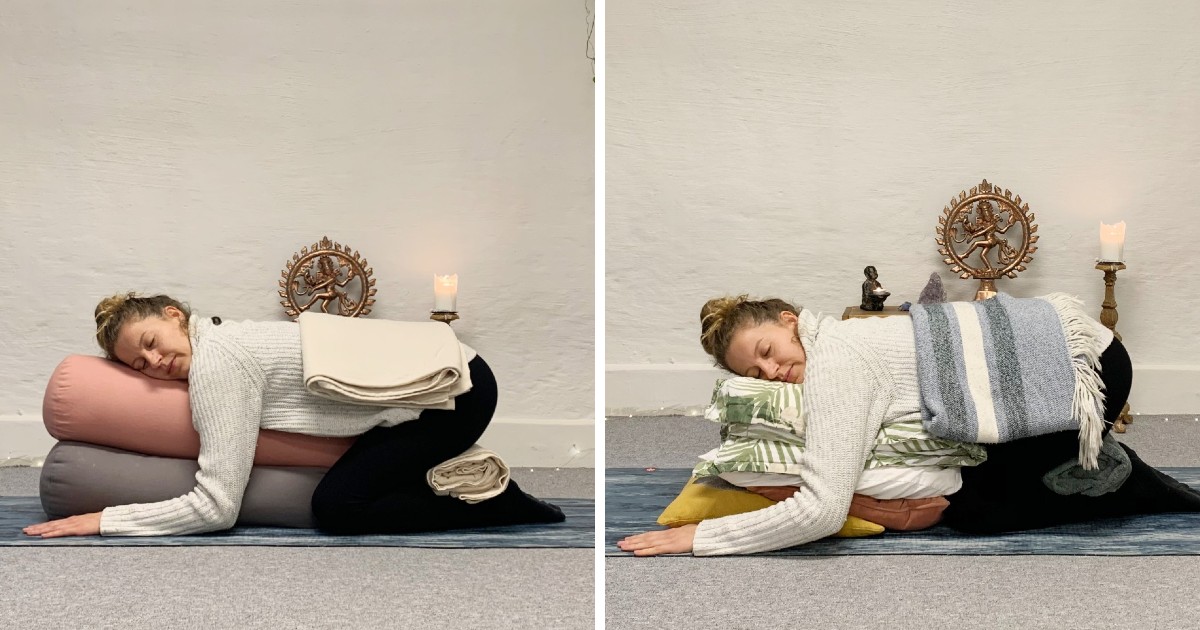
Har du inget yogabolster hemma? Bulla upp med kuddar istället.

Liggande fjäril
Sätt dig på yogamattan och placera ett bolster bakom dig, längs med mattan. Placera sedan ett block under ditt bolster så att ena sidan av bolstret höjs upp. Sätt dig med ryggen mot den låga sidan av bolstret och för samman fotsulorna mot varandra. Lägg ett bolster under knäna, eller placera block eller vikta filtar under dem. Luta dig sedan bakåt och lägg dig med ryggen över bolstret. Du kan lägga vikta filtar under armar och händer för extra komfort och vika en filt att lägga under huvudet för att minska eventuella spänningar i nacken. Lägg en filt över dig och en ögonkudde över ögonen. Andas djupa, sköna andetag och vila här i 5-20 minuter.
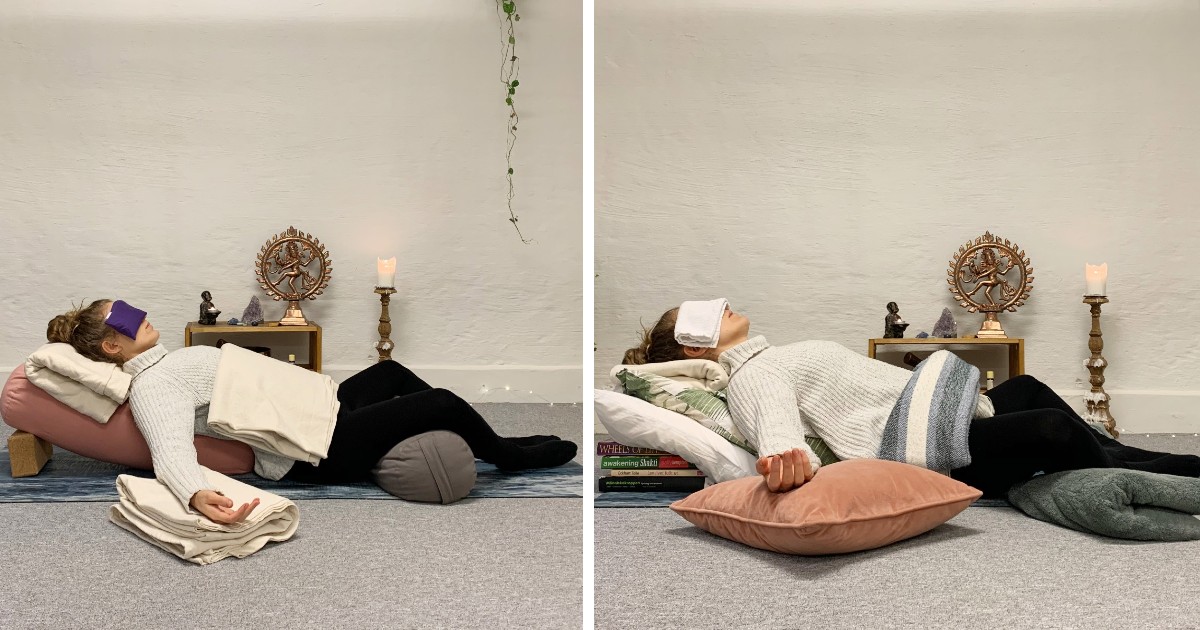
Saknar du yogapropsen som nämns här? Bolster kan bytas ut med kuddar, filtar mot handdukar och block mot böcker. Som ögonkudde kan du använda en sjal eller liknande.

Mer läsning om restorative yoga och enkla övningar du kan göra hemma

Videotips för dig som vill göra restorative yoga hemma

Yogobe Video: t96z Yogobe Video: 9r5f Yogobe Video: 3fe6 Yogobe Video: 24te

För att se en hel video behöver du vara inloggad som betalande medlem hos Yogobe. Ny till tjänsten? Prova gratis i 14 dagar, utan bindningstid – klicka här och kom igång direkt!

Öppna inlägget
Hur fortsätter vi med det som är meningsfullt när livet känns svårt?

Hur fortsätter vi med det som är meningsfullt när livet känns svårt?

17 december 2020 | Av

Den här vintern kan vi alla vara i riskzonen för depressivitet. Isolerade från nära och kära, långt bort från roliga planer och socialt umgänge. Så hur kan vi fortsätta med det som är meningsfullt för oss – inom nya ramar? Hur kan vi ta hand om oss själva så att vi orkar hjälpa andra? Läs mer om varför självmedkänsla behövs i dessa tider av oro.

När oron sprider sig som en löpeld

"Ingenting får hända dig
Nej vad säger jag
Allt måste hända dig
och det måste vara underbart."
– Bodil Malmsten

Varje gång jag känner oro för mina barn vänder jag mig till det här citatet. För att unna dem ett liv med underbara ögonblick måste jag våga låta dem utforska och utmana. Med ett ständigt överhängande hot om lidande, smärta och misslyckanden. Det är inget jag vill att de ska uppleva, men jag vet att livet alltid kommer med två mynt av allting och att baksidan av lycka är lidande.

År 2020 har verkligen varit ett märkligt år. Plötsligt är lidandet inte bara närvarande i små mörka moln utan istället är det som ett dundrande åskväder som gör himlen svart och aldrig vill flytta på sig. Den vanliga svenska vinterdeppen som kommer i och med mörker och kyla knackar som vanligt på dörren. Men detta år är det inte bara de som brukar dämpa sig i takt med mörker och kyla som mår dåligt. Nu mår en majoritet dåligt. Få finns det som har kraft nog att lyfta andra. Oron sprider sig som en löpeld och matas ständigt på från politiker, vårdpersonal och alla vi känner. Vi behöver ta det hot som hänger över oss på allvar.

Självmedkänsla behövs mot lidandet

Problemet i det är väl som vanligt detta: Att de som mest behöver ta det till sig slår det ifrån sig medan de som behöver slå det lite ifrån sig går in i det med hull och hår. Det har inte undgått någon hur vårdpersonalen går på knäna och därför behöver inte heller jag gå in i det. Men svallvågorna som kommer efter Coronans första, andra och möjliga tredje våg, vad blir de? Som psykolog, med vana att nyansera och tänka utifrån olika perspektiv, så undrar jag så vad som händer med de som behöver samhällets bärande funktioner. Barnen som inte har det bra hemma med sina föräldrar, kvinnorna som får motta misshandel istället för omfamning av sina män, personer med psykisk ohälsa såsom depression, social fobi och ätstörning som isoleras utan möjlighet att utmanas och stödjas genom sina processer såsom de behöver, äldre som får minskade sociala kontakter som redan varit gränsfall på för få innan.

En klok handledare sa till mig att självmedkänsla behövs FÖR att vi lider, som ett slags motgift till lidandets nedbrytande natur. I dessa tider måste vi alla försöka ta hand om oss själva för att inte förgås av ältande tankar och trötthet som förlamar oss. Vilket är svårt när det strömmar negativa besked och signaler i omgivningen mot oss! Den här vintern är vi alla i riskzonen för depressivitet. Mitt i isoleringen från nära och kära, långt bort från roliga planer och sociala tillställningar. Till och med bortom goda vanor. Då måste vi fråga oss vad vi kan göra för att fortsätta med det som är meningsfullt för oss, fast inom nya ramar. Vi måste anpassa oss till restriktioner men med ett ansvar om att göra det på ett sätt som ändå ger utrymme till självomhändertagande. För när vi tar hand om oss själva så har vi kraft även att ge till andra. Vi landar i vår praktik för att sedan ta med den långt utanför mattan, in i vardagen. För det kommer finnas även en vardag även efter Corona.

Kriser skapar perspektiv

Jag önskar och hoppas att vi står på andra sidan om den här krisen och har en ökad tacksamhet mot den planet vi bor på. Att vi tar hand om den bättre så den orkar fortsätta bära våra barn genom livet. Jag hoppas att vi ser att julen inte behöver fyllas av konsumtionshets. Jag hoppas att vi ser värdet i att främja en god integration i samhället på alla sätt vi kan och att vi tar barns rättigheter på allvar. Jag hoppas att starka kvinnor får komma till tals för att bära de som inte orkar. Jag hoppas helt enkelt på mer medmänsklighet, värme och omsorg om varandra. Kriser har en förmåga att skapa perspektiv. Låt oss hoppas att denna kris motiverar oss till dessa förändringar.

I dessa hårda tider hoppas vi att vi kan bidra med något på vägen. Något som hjälper dig styra dig på rätt väg även när omständigheterna är annorlunda. Något som kan vända nedgång till uppgång eller få upp dig där du fastnat. Vi önskar dig också en så bra jul som möjligt.

Med värme,
Maria Johansson

Så kan du ta hjälp av YOMI-kurser online

YOMI är en metod som kombinerar psykologi med yoga- och mindfulnesspraktik. De tre YOMI-kurserna på Yogobe är kurser som är riktade till dig som upplever någon form av psykisk ohälsa. I vissa fall i lite enklare, mer allmängiltig form, och i vissa fall lite svårare problematik. Som kurser hos Yogobe finns YOMI vid stress & oro, YOMI vid utmattning eller smärta samt YOMI vid nedstämdhet

Läs mer om YOMI-kurserna, depression och oro

Videotips

Yogobe Video: 8ts3 Yogobe Video: 2e6h Yogobe Video: 24ag Yogobe Video: ud83

För att se en hel video behöver du vara inloggad som betalande medlem hos Yogobe. Ny till tjänsten? Prova gratis i 14 dagar, utan bindningstid – klicka här och kom igång direkt!

Öppna inlägget
Forskning: Att hantera stress i orostider

Forskning: Att hantera stress i orostider

15 december 2020 | Av

Hur hanterar vi den stress som oron och ovissheten kan väcka just nu? Pandemin fortsätter och är nu en del av vår vardag. American Psychological Association listar några tips mot stress i orostider. Läs de forskningsbaserade tipsen här!

Hantera stress i tider av ovisshet och osäkerhet

Julstressen brukar eventuellt vara i sitt esse just nu med julfester, släktmiddagar och julklappar. Men i år är en annorlunda jul. Covid-19 gjorde entré, förde med sig enorma orosmoln och sorg. Människor vi älskar och bryr oss om blir sjuka. Människor förlorar sina jobb. Att säga att det här året varit stressfullt för många är en underdrift. Hur kan vi, så gott vi kan, försöka minska den stressen? American Psychological Association har listat några punkter som kan vara till hjälp. Men först och främst: alla känslor är tillåtna. Är man ledsen, arg, frustrerad, sorgsen – låt dig vara det. 

Tips mot stress 

  • Var snäll mot dig själv. Vissa har lättare att hantera osäkerhet och ovisshet, var inte för hård mot dig själv om din tolerans mot ovissheten är lägre än någon annans. Försök ha tålamod under tiden.

  • Kom ihåg tidigare stressfyllda situationer du tagit dig igenom. Ge dig själv en klapp på axeln för det. Reflektera över vad du gjorde då som hjälpte dig, och vad du kanske behöver göra annorlunda den här gången.

  • Utveckla nya talanger. Om du har orken och viljan att testa något nytt, varför inte? Mycket går att göra online nu: som att testa en ny träningsform eller lära sig ett nytt språk, och naturen är alltid öppen: ta en annan promenadväg, gå till ett nytt naturreservat och spana. Förutsatt att du faktiskt är frisk: det är inte fel att utvecklas och få ny energi, även när världen är upp och ner.

  • Begränsa intaget av nyheter. Ja, vi behöver vara uppdaterade om vad som gäller. Men du behöver inte kolla nyhetsflödet varje kvart. Välj din stund av nyhetsuppdatering, och kanske bra att skippa den precis innan läggdags? Orosmolnen blir bara blir större om du läser och ser negativa nyheter före du ska sova.

  • Försök att inte älta saker utanför din kontroll. När ovisshet och oro slår till så är vi många som ser tusen worst-case scenarier direkt. Men försök ta dig ur dina loopande tankar om vad som skulle kunna hända. (Länka till: Testa en meditation för att hantera känslor?)

  • Lyssna på dina egna råd. Fråga dig själv: om en vän delade sin oro med dig, vad skulle du säga? Att försöka se sin situation utifrån kan hjälpa till att ge perspektiv.

  • Ta hand om dig själv. Håll i dina hälsosamma rutiner trots oro och ovisshet – kanske behövs mer än någonsin? Försök att äta bra, röra på dig om du är frisk, sova tillräckligt. Testa yoga och meditation hemma, en liten paus på 10 per dag min kan räcka för att landa i dig själv.

  • Sök stöd hos dem du litar på. Många av oss isolerar sig när vi är stressade eller oroliga. Socialt stöd är viktigt – så hör av dig till vänner och familj, även om du inte känner för! Det går alltid att ringa, eller att ses digitalt.

  • Kontrollera det du kan. Fokusera på det som är inom din kontroll, även om det är något så enkelt som att planera middagen, ta fram kläder för morgondagen, ta din lunchpromenad. Sätt rutiner som kan ge dina dagar och veckor lite värmande struktur och tröst.

  • Be om hjälp. Om du har svårt att hantera stress och oro, be om professionell hjälp. Experter finns till för att hjälpa dig utveckla hälsosamma sätt att hantera stress och oro. Hitta till exempel en psykolog nära dig eller online.

Fortsätt ta hand om din hälsa.
Fortsätt hålla avstånd.
Fortsätt hålla hjärtat varmt.

Källa: American Psychological Association 

Lästips om oro, utveckling och forskning

Videotips för känslor, medvetenhet och loving kindness

Yogobe Video: 4f9wYogobe Video: 8ex6Yogobe Video: p3k7Yogobe Video: s32z

För att se en hel video behöver du vara inloggad som betalande medlem hos Yogobe. Ny till tjänsten? Prova gratis i 14 dagar, utan bindningstid – klicka här och kom igång direkt!

Öppna inlägget
Restorative yoga – an antidote to stress

Restorative yoga – an antidote to stress

06 december 2020 | Av

I fell in love with restorative yoga – this amazing antidote to stress – 14 years ago when it became my friend in need and helped me through a period of illness. Here I share my experiences from this amazing yoga style, why restorative yoga is so powerful  and how it can be a tool for stress release. 


Restorative yoga – calming and relaxing

The impact restorative yoga has in releasing stress and tension is very personal. About 14 years ago I had a bout of serious asthma attacks that were life changing. I was continually in and out of the hospital and put on high levels of cortisone for an extended period that created extreme anxiety and panic attacks. I started practicing restorative yoga which was integral to my recovery. Restorative yoga calmed my nervous system, relaxed my body and released tension from my breath, all of which were bracing for and contributing to future asthma attacks. No amount of trying to talk myself out of the situation helped because my whole system was stuck in a heightened state of tension. I needed to bypass my mind and activate the parasympathetic nervous system, which is exactly what restorative yoga does.

Why restorative is the perfect antidote to stress 

Modern life is fast paced and filled with stressors that contribute to a low-grade level of stress that we're often unaware off. This continuous state of SNS arousal has lead to many modern day illnesses such as asthma, cancer, heart disease and stress disorders. Restorative provides the perfect antidote to stress because it creates a supported pause. By completely supporting the body and being still for extended periods the breath, the mind and the nervous system all begins to calm down.

Different restorative poses can be used for different purposes though they all help to calm and quiet the nervous system. There are poses that open the breath and lift our spirits when we're feeling depressed, poses that are supportive and nurturing when we're feeling anxious and poses that target specific parts of the body where tension accumulates.

Restorative yoga releases tension on the physical, mental and emotional level. Since our bodies store all our past experiences, when we let go of the holding in the physical body we often have strong emotional releases as suppressed emotions and past experiences locked in the body bubble up.

One of the advantages of a restorative practice is that it can be practiced by everyone. People who aren't physically able to practice asana (yoga poses), such as the elderly and physically challenged can reap the benefits of deep relaxation and energetic rebalancing. 

Target imbalances with restorative yoga

Restorative poses by themselves open energetic lines in the body because of the amount of time spent in each pose. We have 72,000 energetic pathways in the body and seven major energetic centers or chakras that run along the spine. I’ve developed a restorative series that focuses on balancing the chakras. Imbalances in any chakra over an extended period of time can create imbalance in the others and is often responsible for imbalances in our bodies and our lives. By combining specific subtle body balancing techniques with specific restorative poses we can target chakra imbalances.

Restorative and Ayurveda
Restorative, like asana is an excellent way to correct doshic imbalances. When restorative postures are sequenced and adapted for specific imbalances along with specific yoga nidra practices, visualizations and mantras they are even more powerful.

Restorative and Yoga Nidra 
I grew up practicing yoga nidra in my teens in Mumbai, India. The stillness it led me into had a profound impact on my practice and my teaching. Restorative and yoga nidra compliment each other perfectly because restorative leads people into a place of deep stillness which when followed by yoga nidra allows for an even deeper state of surrender enabling the release of past experiences locked in the subconscious and unconscious.

Restorative and the Koshas
The koshas are our five vibratory fields that make up who we are. In restorative, my focus has been on integrating the koshas. I design practices that focus on releasing tension from all five vibratory fields because tension in any of these fields disconnects us from our essence creating unease and a lack of clarity in our lives. By integrating visualization, pranayama, kriya techniques, and mantras into restorative we release tension from these sheaths enabling us to rest back to spirit and bring wisdom and clarity into our lives.

Further reading on restorative and yoga nidra

Videos online with restorative and yoga nidra

Here is a playlist with videos on restorative yoga – all classes in one playlist!

Yogobe Video: g7x9 Yogobe Video: 38tr Yogobe Video: x2b5 Yogobe Video: 24ag

To watch a full video you need to be logged in as a paying Yogobe member. Haven't tried Yogobe before? Try it for free during 14 days – get started here!

Öppna inlägget
How to face anxiety and stress this Christmas

How to face anxiety and stress this Christmas

02 december 2020 | Av

Christmas tends to be a stressful holiday - and because of the pandemic, Christmas will be different this year. Maybe you can't celebrate Christmas with your family. Maybe your economy is at rock bottom. Maybe you are worried about your loved ones, or about the future? In this blogpost I share some thoughts on how we can meet feelings of stress and anxiety this Christmas.

A different kind of Christmas - allow yourself to face all emotions

This Christmas will be different for all of us.

It is important to allow yourself to be sad about not being able to spend time with family and friends. Take care of your sadness or other difficult feelings that may arise. Try to face your difficult feelings instead of trying to push them away. When we face our feelings, they eventually subside, but if we push them away, they remain in us and take on a life of their own. If we dare to meet our feelings, there will also be room for the positive emotions. Remember, it is okay to have fun even though you may be on sick leave. It is ok to have fun even though there is a pandemic going on.

While we need to allow the feelings of sadness and disappointment regarding that this Christmas will be different, it is also important not to forget everything that is actually available to us, even this year. Gratitude training is a powerful tool that helps us shift our focus from the negative to the positive. Starting and ending the day with a gratitude exercise can be valuable. However, it is important not to use gratitude training as a way to avoid difficult feelings.

Christmas is a holiday that often times involves a lot of drinking and alcohol. This year in particular, it may be even more important to limit both alcohol supply and alcohol intake. Sometimes we drink alcohol to alleviate anxiety and difficult feelings, but alcohol instead tends to trigger anxiety. In addition, high alcohol intake impairs our sleep, which is our main source of recovery.

Nature is always available

What is the most important thing around Christmas, for you? How can you manifest these values, despite the pandemic? Maybe you can record a digital Christmas greeting to someone you would have liked to celebrate Christmas together with this year. Or maybe something completely different, only your imagination sets the limits. Try to keep the level of ambition down so that your gift does not create stress and pressure. It is seldom the gift itself that is significant, but the intention itself.

Try to spend as much time as possible in nature. Nature is always there for us and now more than ever, there is reason to strengthen our ties to nature. Being in nature in silence adds an extra dimension to our experience. The silence opens up our senses and helps us to fully take in our surroundings. Nature also lowers our stress level and stimulates the senses in a calm way. In nature, we often feel a kind of reverence and an experience of meaning and context.

Take time for rest and recovery

For many of us, Christmas is a holiday focused on children. We want to give our children memories for life from their Christmases. This year, there may be an even greater tendency to try to compensate for this strange year by trying to create the "perfect Christmas". It is not at all difficult to understand, but it is an impulse that can be important to create awareness about and try to limit. Try to stay focused on what really matters and lower the bar so that you can be present. Try to face yourself with self-compassion instead of self-criticism when your strengths are not enough for everything you want or plan.

You can always give yourself compassion and kindness, it usually makes the difficult feelings a little less heavy to bear. Listen to your own needs and create time for rest and recovery. Showing our children that we prioritize well-being instead of achievement and perfection is probably one of the best Christmas presents we can give them. A gift for life.

Further reading

Video recommendations

Yogobe Video: z5a3 Yogobe Video: fw68 Yogobe Video: 4pf2 Yogobe Video: fp68

To watch a full video you need to be logged in as a paying Yogobe member. Haven't tried Yogobe before? Try it for free during 14 days – click here to get started!

Öppna inlägget
December på Yogobe - lugn yoga och loving kindness

December på Yogobe - lugn yoga och loving kindness

01 december 2020 | Av
Yogobe

Vad betyder december för dig? Även om vi ofta förknippar månaden med julledighet, adventsmys och glöggmingel så är stress över julklappar, julbordet och släktträffar något som många kan relatera till och i år bidrar pandemin med ännu ett orosmoment. Under december månad vill vi på Yogobe inspirera till hur du möter julstressen på bästa sätt – genom videor, playlist och inspiration till lugn yoga, avkoppling och kärleksfull vänlighet.

Ge dig själv tid för vila

 Det finns många saker som vi kan stressa upp oss inför julen, även om det vi innerst inne önskar är att få uppleva julefriden. I år bidrar coronasituationen med ytterligare ett orosmoment – kommer vi kunna fira jul med våra nära och kära på ett säkert sätt?

Stunder för vila och återhämtning är viktigt för vårt välmående och för att motverka stress. Genom att möta aktivitet och stress med stunder av avkoppling och vila är det enklare att möta oss själva och andra med kärleksfull vänlighet. I december har vi samlat videor och vägledning inom återhämtande yogaformer som yinyoga, restorative yoga och yoganidra, samt klokheter från Mona Drar, Jennie Wadsten och Pål Dobrin från Team Yogobe som du kommer kunna läsa här i bloggen.

Fem tips för att motverka julstressen

  • Börja varje morgon med 10-15 minuter för dig själv. Ta 20 långsamma andetag, meditera eller gör en kort yogaklass här på Yogobe.

  • Fundera på vad som verkligen är viktigast och att släppa tanken över att allt ska bli perfekt. Skriv ner en lista på de fem saker som du vill prioritera i jul.

  • Var snäll mot dig själv – se dig själv DÄR du är och anpassa din insats efter vad du orkar, förmår och klarar av just nu, just i år.

  • Planera in tid för återhämtning under dagen. Kanske en yoga nidra eller en lugn promenad på lunchen? Eller ett skönt yin- eller restorative yogapass på kvällen.

  • Avsluta dagen med en tacksamhetsövning. Fundera på och skriv ner fem saker som du är tacksam för.

Månadens utvalda playlists

Här har vi samlat några playslists som du kan vända dig till när du behöver pausa och ta en lugn stund för dig själv, samt en playlist om hur du använder yogaprops i lugna yogaformer.

  • Yin & Restorative – en playlist fylld med lugna och återhämtande yinyoga och restorative pass.

  • Lär dig hantera stress – klasser, föreläsningar med andning och knep för att lära sig hantera stress.

  • Restorative Flow – lugna, återhämtande klasser med Milla Floryd som hjälper dig att varsamt fylla på med ny energi.

  • Props för för meditation och lugn yoga – lär dig använda olika yogatillbehör (och hur du ersätter dem) för yogastilar som yinyoga, restorative yoga och yoga nidra.

Julklapparna som du kan köpa på Yogobe

Vi tycker att träning online är årets julklapp – ge din nära och kära förutsättningar för ett hälsosamt liv med Yogobe i julstrumpan!

  • Köp ett presenkort och få fullständig tillgång till Yogobes videobibliotek, playlists och program – det finns flera olika valörer att välja på.

  • Värva vänner - du som är medlem hos oss kan ge dina vänner sina 21 första dagar med Yogobe helt gratis! Din access till videobiblioteket uppgraderas automatiskt med 30 bonusdagar för varje person som investerar minst 189 SEK som medlem på Yogobe efter att ha blivit medlem med din värva-vän kampanjkod.

  • Halva priset på tre av våra mest populära onlinekurser  – fram till 31 december.

– Yomi Yin
En 10-veckors onlinekurs för att bättre hantera oro och stress (ord.pris 999:-)
Yogasekvensering
En onlinekurs med Milla Floryd för att utvecklas som yogalärare (ord. pris 1990:-)
Yoga philosophy
En djupdykande onlinekurs med Simon Krohn för fördjupad förståelse för yogans bakgrund (ord. pris 1990:-)

Läs mer om stress och återhämtning

Videotips för att komma ner i varv

Yogobe Video: sc62Yogobe Video: 38trYogobe Video: x3u2

För att se en hel video behöver du vara inloggad som betalande medlem hos Yogobe. Ny till tjänsten? Prova gratis i 14 dagar, utan bindningstid – klicka här för att komma igång direkt!

Öppna inlägget
Open up to fill you up – 3 tips to combat fatigue

Open up to fill you up – 3 tips to combat fatigue

29 november 2020 | Av

Are there any exercises that are good to practice after experiencing fatigue? You keep hearing that you should listen to your body. But how do we know WHAT we really should be listening for? I want to share with you three therapeutic principles that can help you when you practice.

How do you fill up with energy when feeling fatigued? 


A client who is recuperating from fatigue asked me the question. Which exercises of the ones I recommended should she prioritize if she lacks time or energy? I tell her to listen to her body and judge herself what she needs, to be perceptive of her daily form. After considering these factors, she can decide what her body needs and what will support her system. Maybe these therapeutic principles can help you understand what you need to listen for.

​Three therapeutic principles to support your energy flow

1. Open the container 
If the body feels tense, stressed and trapped in any way – start by practicing yoga that makes you relax. It could be asanas that stretches, opens up and winds you down. When you have found relaxation, you have created an open container for prana to flow through.

2. Boost your energy
Are you relaxed but still feel tired?  Refill your prana/energy. Prioritize practicing with a lot of pranayama, breathing exercises. The breath of fire for 11-31 minutes is amazing. Or try a sequence that gives you an energy boost when needed, to lift you out of the tiredness or resistance.

3. Aim the energy where it is needed
Are you relaxed and feel that you have prana/energy – start aiming it to the parts of the body that are in need of support. If it's fatigue you are recuperating from I recommend a session for kidneys and adrenal glands. But there are many different movements for different parts of the body, different organs, chakras and parts of the mind.

The logic is simple: If there isn't any room left, there is no space to refill with energy. If you don't have any energy, you can't aim it. Start by opening up the meridian system and relax, so that you're open to receive.

I hope this will help you in your choices of what you need when you're on the yoga mat.

Sat nam

Further reading

Yoga online – videos for energy and balance

Yogobe Video: 7d5x Yogobe Video: x8u7 Yogobe Video: u97d Yogobe Video: z69a

To see a whole video you need to be logged in as a paying Yogobe member. Haven't tried Yogobe before? Try it for free during 14 days – click here to get started right away!

Öppna inlägget
Yin yoga – balancing the Yin and Yang of yoga 

Yin yoga – balancing the Yin and Yang of yoga 

21 oktober 2020 | Av

To find balance in our yoga practice it is important to balance yin, recovery, and yang, activity.  In this blog post I will guide you through the practice of yin yoga, the concept of yin and yang, and explain how yin yoga may help you release tension and find balance in life.

Yin yoga can reduce tension in body, mind and soul

Our world’s biggest problem is not poverty, drugs, fear of war, or hunger. It is tension. All kinds of tension lead to all kinds of imbalances and insecurities. If one knows how to free oneself from tension, one has the solution to one’s problems in life. If you are able to balance your tensions, you then automatically learn how to balance your emotions, anger, and passions.

Yogic philosophy as well as modern psychology sum up three basic types of tension that are responsible for all the agonies in modern life. These are muscular tension, emotional tension, and mental tension. Through the art and practice of yin yoga, these tensions can be progressively reduced. Yin yoga focuses on the fascia, the type of tissue that keeps us together. Fascia is the soft tissue component of the connective tissue that provides support and protection for most structures within the human body, including muscle. Fascia is what gives us our form and what makes it possible for us to work our amazing bodies in the ways we do.


The fascia is interlinked with our nervous system and our brain through what’s called tensegrity, or “The Architecture of life.” Tensegrity indicates that the integrity of a structure—in this case the human body and mind—derives from how all parts are wired together, not how they are stacked.

We have fascia everywhere, and our nervous system is enclosed in fascial membranes and continues as nerve sheaths to every corner of the body. Thus different types of strain or tension affect the structure in different ways. From a yogic perspective you could say that we are wired together by spirit, and if spirit is limited in its expresssion, the prana, or life force, will be disrupted, and there will be less freedom for energy to move. Yogis would say that less Shakti equals less flow in life. Better flow of Shakti equals better flow in life.

Passivity is the key to find release in yin yoga

Our yoga practice should be a blend of yang/out/action/contraction and yin/in/observation/extension to make the whole balanced and to affect our entire health to move towards homeostatis (the maintenance of equilibrium). Yang yoga is a more vigorous yoga practice that targets the muscular tissue and through movement create heat. Examples of yang based yoga is Ashtanga Vinyasa, Poweryoga and Anusara yoga.

Through the practice of yin yoga, one targets the fascia/connective tissue in the body, which makes it a marvellously therapeutic tool for healing bodily, mental, and emotional imbalances.

When you participate in a yin yoga class, you will experience mostly seated, supine, or prone poses, and you will stay in the poses, not moving, with your muscles relaxed for long periods of time—up to five minutes, sometimes longer. Staying muscularly passive for long periods of time gently stress the connective tissue (which gets stiff and immobile with age and through too much or too little use). Yin yoga poses focus mainly on the lower parts of the body because the abundance of dense connective tissue around the joints in this areas requires extra care and attention.

Balancing Yin and Yang

Yin yoga introduces us to the natural edges of our beings in a graceful way. If we push our edges or lead a life that is constantly yang; we move into too much yang, burning energy rather than conserving. On the other hand, if we draw inward too much or lead a too passive lifestyle, we start moving away from life and being present, into the past, sliding backward. Too much yin or too much yang creates imbalances. They need to co-exist side by side in order for us to live our lives in harmony and balance.

Yin and yang can be described as two variables; they are either on the opposite ends of a cycle, like the seasons of the year, or opposites on a continuum of energy or matter. The opposition is relative and can only be understood through relationships between the two.

For example: Water is yin relative to steam but yang relative to ice. Nothing is totally yin or yang. Just as a state of total yin is reached, yang starts to grow. This is evident in the yin yoga practice, since after you have gotten deep into relaxation and mental stillness in a yin yoga pose, the blood circulation increases and you can start to feel heat inside. They constantly transform into each other, just as there can be no energy without matter and no day without light.

If you are accustomed to sweating your way into cool poses, yin yoga may at first glance seem too simple, slow, and boring to some. But this practice of long, passively held floor poses is deeply nourishing and has a myriad of benefits for any yoga practitioner.

Yin yoga – the practice of letting go

In yin yoga you move inside with the mentality as the observer, not the as the force of action where you want to change and go to the outer edge. If one does yin yoga and aim to push and move away from discomfort, one experiences no effect rather than more frustration and tension and less circulation. With the attitude of the observer, the opposite happens. So when one practices yin yoga, I find it valuable to have some techniques like breath and visualization in order to calm the restless and aggressive mind down.

When you come into a position, move slowly and gently into it. Don’t try to follow a picture or an idea of how far you should go in the exercise. In yoga there are no aesthetic ideals and no end result to strive for. Pause frequently and listen to your body. Wait for the body and mind to respond before going deeper into the position. Finding your limit doesn’t always need to mean pushing yourself.

Many yoga practitioners loose their sensitivity to the body’s signals as they go through the motions of a yoga practice day after day, perhaps focusing too much on achieving a physical goal, such as a sculpted body or mastering a new pose. Look instead for just the right amount of intensity in each exercise. Aim for a sensation that you, through the breath, can just be with during each moment of breathing, not having to do or fix anything.

This text has been inspired by content from my book: Yin Yoga – An individual practice. If you like what you read you can buy it here!

Learn more about yin yoga:

Video recommendations

Yogobe Video: a7d5 Yogobe Video: a2u5 Yogobe Video: fex6 Yogobe Video: 7bw4

To watch a full video you need to be logged in as a paying Yogobe member. Haven't tried Yogobe before? Try it for free during 14 days – get started here!

Öppna inlägget